
Kamusta, Ka-Optimalliving!
Important disclaimer: This article is for general informational purposes only and is not a substitute for professional medical advice. If you suspect a specific deficiency or medical condition, please consult a licensed healthcare professional for proper diagnosis and treatment.
Let me be straight with you: I spent 15 years on night shift.
Fifteen years of reversed sleep schedules, experienced the effects of eating too much unhealthy foods, no daily exercise routine and just work-work-work everyday on my desk, and telling myself “kapag may time na magexercise na ako at umpisahan ko na ang healthy lifestyle.” Sound familiar? For a lot of Filipinos – whether you’re working irregular hours, juggling two jobs, or raising a family on a budget – looking for real healthy lifestyle tips for Filipinos often feels like searching for something that simply doesn’t fit your actual life.
The problem is, someday has a way of never arriving.
It wasn’t until I started paying closer attention to how I actually felt – constantly tired, always getting colds, lumalaki nang lumalaki ang tiyan ko – that I realized something had to change. And what surprised me most was this: the changes that made the biggest difference weren’t expensive. Hindi naman pala kailangan ng gym membership o imported na supplements para makaramdam ng pagbabago.
This guide is built around the most practical, realistic healthy lifestyle tips for Filipinos I know – the kind that actually survive contact with real Filipino family life, traffic, deadlines, and a tight budget. Let’s get into it.
Why “Healthy Living” Feels Out of Reach for Many Filipinos
Before we dive into specific healthy lifestyle tips for Filipinos, let’s acknowledge the real barriers – because ignoring them doesn’t make them go away.
Budget is the first one. Healthy food has a reputation for being mahal. Organic this, imported that. The truth is, some of the most nutritious foods available are the affordable everyday ones already sitting in your palengke – malunggay, kangkong, monggo, sardinas, kamote. You don’t need imported superfoods to eat well.
Time is the second barrier. Between work, commute, kids, and household responsibilities, who has time to meal prep or exercise? Most Filipinos are already running on empty before the day is halfway done, and that exhaustion makes any new habit feel impossible to start.
Information overload makes things worse. The internet is full of conflicting health advice – keto, intermittent fasting, supplement stacks. It’s overwhelming, and it often leads to paralysis: hindi ka na gumagawa ng kahit ano kasi hindi ka sigurado kung tama.
And then there’s culture. Our food culture is rich and deeply social – celebrations always involve feasting, and refusing food can feel rude. Managing healthy habits without becoming the killjoy of every family gathering is a real skill that takes practice.
Here’s the good news: you don’t have to overhaul your entire life overnight. Small, consistent changes are what actually work – and that’s exactly what these healthy lifestyle tips for Filipinos focus on.
Pillar 1: Eat Smarter, Not More Expensively
The Filipino diet is not the enemy. Sinigang, tinola, pinakbet, monggo – these are nutritious dishes that have nourished generations. The problem isn’t our food culture; it’s the modern shortcuts we’ve added: too much processed food, sugary drinks, and fried everything.
You don’t need to go on a diet. You need to make small upgrades to what you’re already eating, and this is genuinely one of the most important healthy lifestyle tips for Filipinos on a budget.
Easy food swaps that actually work
White rice doesn’t need to disappear from your plate – just reduce the portion slightly and load up on ulam instead. You don’t have to switch to brown rice overnight, though it’s worth trying eventually. This simple shift improves your nutrient-to-calorie ratio without making you feel deprived.
Fried dishes can become air-fried or steamed versions with minimal effort. An air fryer has become one of the most popular kitchen appliances in Filipino homes, and for good reason – you get the same crispy texture with significantly less oil. No air fryer at home? Steaming, boiling, or baking are equally good alternatives that don’t require new equipment.
Softdrinks and packaged juice are some of the sneakiest sources of empty calories in the Filipino diet. Replacing even one softdrink a day with water and calamansi makes a noticeable difference over time. Salabat, or ginger tea, is especially good for digestion and immunity, and it costs almost nothing to make at home.
Processed merienda like chips and crackers are convenient but nutritionally empty. Boiled kamote costs almost nothing and keeps you full far longer. A ripe banana is essentially nature’s energy bar, already wrapped and ready to go.
Most nutritious affordable foods in the Philippines
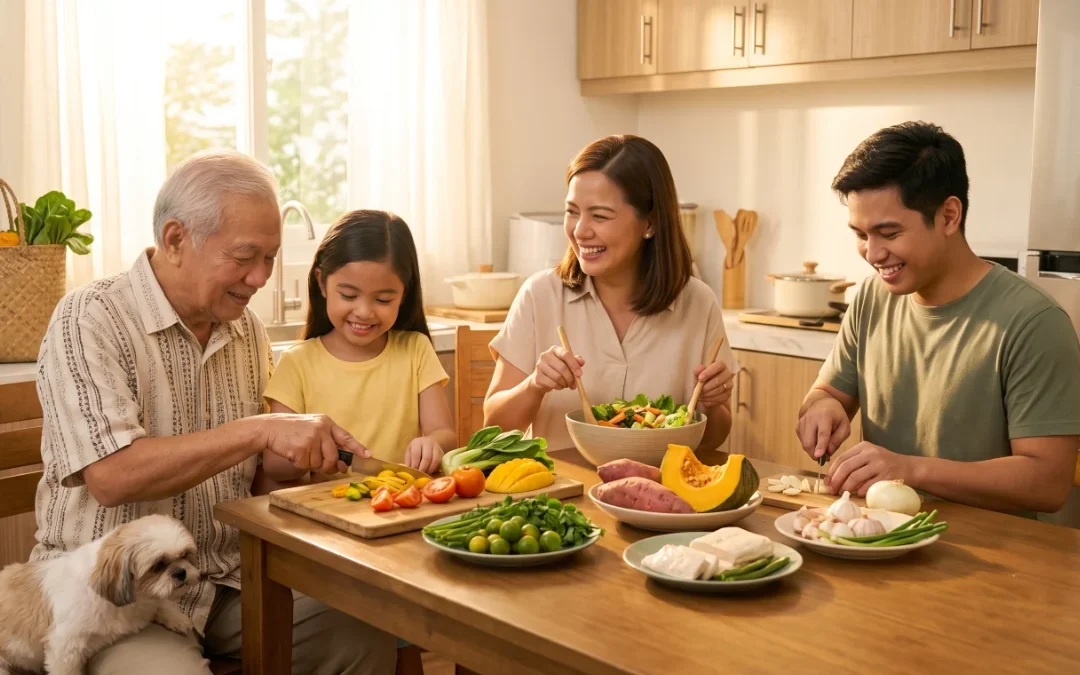
You don’t need expensive superfoods when you already have access to these. Malunggay is one of the most nutrient-dense plants in the world, packed with iron, calcium, Vitamin C, and protein – and it’s often free from a neighbor’s backyard. Kangkong is rich in iron and Vitamin A and goes with almost everything. Monggo offers protein, fiber, and iron in one classic, affordable dish. Sardinas, especially canned with the bones included, deliver omega-3, calcium, and protein in one of the most underrated health foods on the market. Eggs are a complete protein source with Vitamin D and B12, always affordable and always reliable. Tofu provides plant-based protein, calcium, and iron at a very low cost. Kamote offers fiber, Vitamin A, and natural sweetness without the blood sugar spike of refined sugar.
The truth is, a healthy Filipino meal doesn’t have to cost more than your usual budget. It’s more about balance than expensive ingredients.
Pillar 2: Move More Without a Gym Membership
Here’s an honest truth about exercise, and one of the most freeing healthy lifestyle tips for Filipinos out there: the best workout is the one you’ll actually do consistently. A ₱3,000 monthly gym membership means nothing if you only go twice.
According to the CDC, adults need at least 150 minutes of moderate-intensity physical activity each week, which can be broken into manageable chunks like 30 minutes a day, 5 days a week. That target is far more achievable than most people assume, and it doesn’t require a gym at all.
Free ways to move more every day
Walking is genuinely underrated and extremely effective. If you can add even 20 to 30 minutes of brisk walking to your day – during a lunch break, after dinner, or as part of your commute – you’re already doing more than the majority of Filipino adults. Regular physical activity helps you feel better, function better, and sleep better almost immediately, and adults who sit less and move more gain real health benefits even in small amounts.
YouTube workouts offer an almost unlimited supply of free programs, including Filipino fitness creators who teach in Tagalog and design routines for home environments with zero equipment. Search for “home workout Philippines” or “Zumba for beginners Filipino” and you’ll find hundreds of free options.
Barangay sports programs are another great option. Many barangays offer free or very affordable basketball, volleyball, and fitness programs – and these are especially great for social motivation, since mas masaya maglaro pag may kasama.
Dancing counts too. Zumba at home is a perfectly legitimate cardio workout. If it makes you sweat and you genuinely enjoy it, it counts toward your weekly activity goal.
Affordable home workout gear worth investing in
If you want to level up your home workouts without spending much, a jump rope at ₱99 to ₱400 on Lazada is arguably the best bang-for-your-buck cardio tool available. A 10-minute skipping session burns serious calories and improves coordination. Resistance bands at ₱300 to ₱800 on Lazada can replace an entire set of dumbbells at a fraction of the cost, great for strength training, stretching, and rehab. A yoga mat at ₱400 to ₱1,500 on Lazada is essential for floor exercises and stretching, and it doubles as a quiet play area for the kids.
👉 I’ve included all three of these in my Recommended Wellness Finds page, where you can browse specific picks available on Lazada PH.
The goal isn’t to become an athlete. It’s to move your body consistently, at least 3 to 4 times a week for 20 to 30 minutes. That’s genuinely enough to see meaningful health improvements over time.
Pillar 3: Take Sleep Seriously
If there’s one habit Filipinos consistently undervalue, it’s sleep – and this is one of the healthy lifestyle tips for Filipinos that deserves far more attention than it usually gets.
Hindi kasalanan ang matulog. Sleep is not laziness; it is a biological necessity. During sleep, your body repairs tissue, consolidates memory, regulates hormones, and resets your immune system. When you consistently cut sleep short, everything else suffers: your energy, your mood, your immune function, and your ability to make good food choices the next day.
According to the CDC, adults aged 18 to 60 are recommended to sleep at least 7 hours each night to promote optimal health and well-being, and sleeping less than 7 hours per night is associated with increased risk for obesity, diabetes, high blood pressure, coronary heart disease, stroke, and frequent mental distress. Most Filipinos, especially those working irregular shifts, get significantly less than this.
Why Filipinos sleep poorly
Night shift schedules and irregular work hours are a major factor – I know this firsthand. Excessive screen time before bed is another, since ang daming notification na nakaka-distract. Stress and overthinking keep many Filipinos awake well past their intended bedtime. Heat and humidity in our tropical climate make falling asleep harder. And noise in shared living spaces, common in many Filipino households, disrupts sleep quality even when total hours seem adequate.
Practical steps to sleep better
Set a consistent bedtime, even on weekends. Your body has an internal clock, or circadian rhythm, that works best with consistent signals. Going to sleep and waking up at the same time every day, even on weekends, is one of the most powerful things you can do for sleep quality.
Stop scrolling 30 minutes before bed. Research on blue light exposure shows it suppresses melatonin production more strongly than other light wavelengths, with effects that persist for hours after exposure – melatonin being the hormone that signals to your body that it’s time to sleep. I know this is hard. Try charging your phone outside your bedroom as a first step.
Keep your room cool and dark. A lower temperature helps signal sleep. If you don’t have aircon, a fan pointed toward you and blackout curtains, or even a simple sleeping mask, can make a real difference.
Cut caffeine after 3 PM. Caffeine has a half-life of about 5 to 6 hours in your body, meaning that 4 PM kape you had is still half-active in your system at 10 PM. Switch to decaf or herbal tea in the afternoons instead.
Get morning sunlight when you can. The CDC recommends getting at least 30 minutes of safe sunlight exposure during the daytime, ideally in the morning, since this helps regulate the body’s internal clock and supports better sleep at night. For night shift workers, managing light exposure strategically becomes even more important for resetting your body’s natural rhythm.
Consider melatonin supplements for occasional sleep support. If you’re struggling to reset your sleep cycle, especially after a shift change, low-dose melatonin taken 30 to 60 minutes before bedtime can help signal to your body that nighttime has arrived. It’s not a sleeping pill – it’s a gentle nudge in the right direction.
Pillar 4: Manage Stress Before It Manages You
Sa culture natin, stress is often worn as a badge of honor. “Busy ako” is practically a Filipino greeting. But chronic stress is not a sign of productivity, and learning to manage it is one of the most overlooked healthy lifestyle tips for Filipinos. Left unmanaged, stress contributes to high blood pressure, weakened immunity, digestive problems, and poor mental health.
You don’t have to eliminate stress entirely. That’s not realistic. But you can build habits that help you process it before it accumulates into something more serious.
Simple, free stress management practices
Morning quiet time makes a real difference. Even 10 minutes before the house wakes up – whether you use it for prayer, meditation, journaling, or simply sitting quietly with your coffee – creates a mental buffer that sets a calmer tone for the entire day.
Talk to someone you trust. Filipinos tend to keep their burdens to themselves, often saying “ayoko na mag-abala.” But naming what you’re feeling, and having someone genuinely listen, is one of the most effective stress relievers there is. This can be a spouse, a sibling, a close friend, or a mental health professional.
Protect your rest days. Pahinga is not a reward you earn; it’s maintenance your body and mind genuinely require. Schedule your days off and guard them the same way you’d guard a work commitment.
Use aromatherapy as a simple daily reset. This sounds like a luxury, but it really isn’t – an essential oil diffuser costs a few hundred pesos on Lazada, and a small bottle of lavender or eucalyptus oil lasts for weeks. The ritual of diffusing something calming before bed or during work genuinely helps create a psychological wind-down cue.
👉 I’ve included an aromatherapy diffuser on my Recommended Wellness Finds page – an affordable option that actually works.
Pillar 5: Supplement the Gaps Without Overcomplicating It
Here’s my honest take on supplements, and one of the more practical healthy lifestyle tips for Filipinos on a budget: food should always come first. But realistically, most Filipino adults aren’t hitting all their nutritional targets through diet alone, especially those with busy schedules, irregular eating habits, or dietary restrictions.
A simple supplement stack doesn’t have to be expensive or complicated. Start with just two: a Vitamin C supplement at 500mg to 1000mg daily, which addresses the most common nutritional gap in the Filipino diet, supporting immunity, skin health, and iron absorption when taken with food. And a quality multivitamin, which covers your bases across B vitamins, zinc, iron, Vitamin D, and other nutrients your diet might be missing – look for brands with FDA registration.
Once those become consistent daily habits, you can consider adding Omega-3 or fish oil if you don’t eat fish regularly, since it supports heart and brain health.
👉 All of these, and more, are on my Recommended Wellness Finds page. I’ve personally curated them with Filipino families in mind, and everything is available on Lazada PH with Cash on Delivery.
Your 4-Week Starter Plan
The biggest mistake people make when trying to apply healthy lifestyle tips for Filipinos all at once is attempting to change everything overnight. Here’s a gentler, more realistic approach instead.
Week 1 focuses on water and vegetables. Drink 8 glasses of water every day and add at least one vegetable to every meal. That’s it – don’t change anything else yet. Just these two things, every single day for a week.
Week 2 adds movement. Bring in 20 to 30 minutes of any physical activity, 3 times this week. Walk, dance, skip rope, do YouTube yoga – anything that gets you moving. Don’t skip two days in a row.
Week 3 fixes your sleep. Set a consistent bedtime and put your phone away 30 minutes before sleeping. Keep this up for the entire week and notice how you feel by Day 7.
Week 4 adds a supplement. Start with Vitamin C or a multivitamin, taken daily with breakfast. Just one supplement to begin with – consistency matters far more than quantity here.
By Week 4, you’ve built four genuine new habits without overwhelming yourself. From here, you can layer in more changes at your own pace.
Frequently Asked Questions about Healthy Lifestyle Tips for Filipinos
Q1: How much does it actually cost to start living healthier in the Philippines? Less than most people assume. The core habits – drinking more water, eating more vegetables you already have access to, walking daily, and sleeping better – cost nothing at all. A basic supplement stack of Vitamin C and a multivitamin typically runs ₱300 to ₱800 per month, and affordable fitness gear like a jump rope or resistance bands costs under ₱1,000 total.
Q2: I work night shift. Can these healthy lifestyle tips for Filipinos still apply to me? Yes, though some adjustments are needed. Prioritize consistent sleep timing even if your “night” is during the day, manage light exposure strategically (dark curtains for daytime sleep, bright light when you wake up), and try to fit movement and proper meals into your schedule even if the timing looks different from a typical 9-to-5 routine. I personally went through 15 years of this, so I understand the unique challenges firsthand.
Q3: What’s the single most important habit to start with if I can only pick one? Sleep. It affects nearly everything else – your food choices, your energy for exercise, your mood, and your immune function. If you fix only one thing this month, prioritize getting at least 7 hours of consistent, quality sleep.
Q4: Do I need a gym membership to get real health benefits? No. Free options like brisk walking, YouTube workout videos, dancing, and barangay sports programs can meet the CDC’s recommended 150 minutes of weekly moderate activity without spending a single peso. A gym membership only helps if you’ll actually use it consistently.
Q5: How do I stay motivated to stick with healthy habits long-term? Start small and stack habits gradually, as outlined in the 4-week plan above. Trying to change everything at once is the most common reason people give up within the first two weeks. Progress over perfection, and consistency over intensity, is what actually creates lasting change.
Conclusion: Hindi Kailangan ng Perpekto
Wellness isn’t about being perfect. It’s not about eating clean 100 percent of the time, exercising every single day, or buying the most expensive supplements. At its core, the most effective healthy lifestyle tips for Filipinos are about making slightly better choices, more consistently, over a long period of time.
Yung mga maliliit na bagay ang nagbibigay ng malaking pagbabago, eventually. Drinking more water. Sleeping earlier. Moving your body a few times a week. Taking a basic vitamin. These aren’t glamorous changes. But they work, and they’re genuinely sustainable for real Filipino family life.
The goal isn’t to look like someone on Instagram. The goal is to have enough energy to play with your kids, to be present for your family, and to grow old without being limited by preventable illness. Para sa atin at sa ating mga mahal sa buhay, that’s worth working toward.
Start small. Stay consistent. Tulungan natin ang isa’t isa. 💪
Important: I am sharing my journey and research, but I am not a doctor. Please read our full [Disclaimer] before making changes to your health routine.
If you found this helpful, check out my Recommended Wellness Finds page for my personally curated product picks – from vitamins and supplements to home health devices and fitness gear. Everything is available on Lazada PH, most with Cash on Delivery.
References
- Benefits of Physical Activity – CDC: https://www.cdc.gov/physical-activity-basics/benefits/index.html
- Adding Physical Activity as an Adult – CDC: https://www.cdc.gov/physical-activity-basics/adding-adults/index.html
- Prevalence of Healthy Sleep Duration among Adults, MMWR – CDC: https://www.cdc.gov/mmwr/volumes/65/wr/mm6506a1.htm
- Sleep, Chronic Disease Indicators – CDC: https://www.cdc.gov/cdi/indicator-definitions/sleep.html
- Comparative Effects of Red and Blue LED Light on Melatonin Levels – PMC: https://www.ncbi.nlm.nih.gov/pmc/articles/PMC12113466/
- 12 Tips for Better Sleep Hygiene – Healthline: https://www.healthline.com/health/sleep-hygiene
The Optimal Setup: Gear for Peak Performance
I’m always searching for practical wellness tools for our community. I’ve recently partnered with Kwikcare to bring you special access to their products. While I’m just beginning to explore their range myself, you can check them out here and use my referral code: ftisagun to support the blog!

Medical Disclaimer
“I am a student of wellness by passion—but I am not a doctor, nutritionist, or licensed medical professional

About Thom Sagun
“I’m a Freelance VA, Computer Technician, father, and fur-parent. After 15 years of navigating the ‘Vampire Shift’ for global clients on different platforms where I get jobs to support my family, I founded Optimal Living PH. My mission is to document the journey of reclaiming my health while working on my own terms practically and to share it with everyone. I’m a researcher and wellness student, passionate about helping fellow independent workers find a better rhythm. Let’s fix the room, fix the rhythm, and build a better life together—it’s never too late to start, Ka-Optimalliving!”