
Kamusta, Ka-Optimalliving!
Important disclaimer: This article is for general informational purposes only and is not a substitute for professional medical advice. If you suspect a specific deficiency or medical condition, please consult a licensed healthcare professional for proper diagnosis and treatment.
May tanong ako sa iyo: kailan ka huling nagpa-check ng blood pressure?
For most Filipinos, the honest answer is “sa clinic – last year” or “hindi ko na maalala kung kailan” or “hindi ko pa naipa-check.” And that right there is exactly why home health devices matter so much for Filipino families today. Many of the most serious conditions affecting our families – hypertension, low oxygen from respiratory illness, fever spikes in kids – give little to no warning before they become emergencies.
Here’s what years of watching people around me deal with preventable health scares have taught me: the best time to monitor your health is before you feel sick, not after. And in 2026, you don’t need a hospital visit to do that. A handful of affordable home health devices can give your whole family a reliable health snapshot anytime you need one – and potentially catch warning signs early enough to actually act on them.
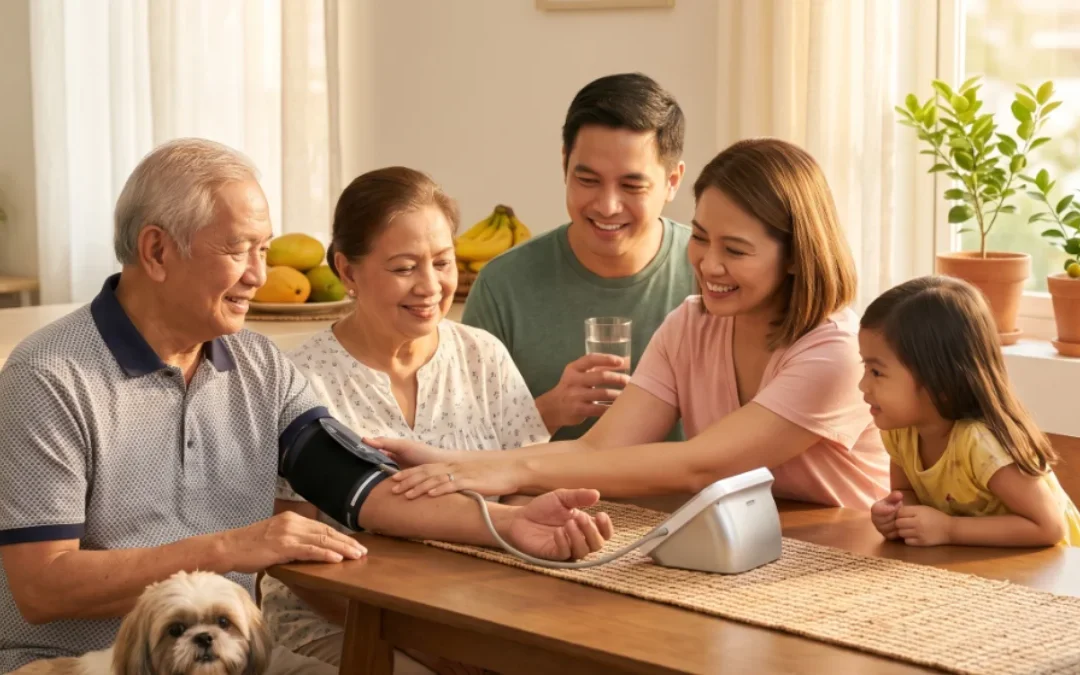
This matters even more if you have elderly parents or grandparents living with you. Lola’s blood pressure. Lolo’s oxygen level after a bad cough. Your own vitals after a brutal, stressful week. These numbers matter – and now you can check them right there in your sala.
In this guide, I’m walking you through the 5 home health devices I genuinely believe every Filipino household should have, in order of priority, with real numbers and real guidance on how to use each one properly.
Why Home Health Devices Matter So Much for Filipino Families
Before we get into the specific devices, let’s look at why this topic deserves your attention – because the numbers are honestly sobering.
A 2024 World Health Organization report found that 33 percent of Filipino adults aged 30 to 79 have high blood pressure, totaling roughly 16.8 million Filipinos living with hypertension. Of that number, only 9.1 million have been diagnosed, and a mere 19 percent – just 3.2 million people – actually have their condition under control. The WHO itself called hypertension a “silent killer” precisely because most individuals with elevated blood pressure have no symptoms and are unaware of their condition until serious health issues arise.
This isn’t a small, isolated statistic. Philippine-specific research backs this up even further. The Philippine Heart Association’s PRESYON-4 survey found that hypertension prevalence in the Philippines rose to 34 percent in 2020, up from 28 percent in 2013 – and other national tracking shows the trend climbing as high as 37 percent by 2021. The message is consistent across every major study: home health devices for Filipino families aren’t a luxury anymore. They’re a genuine necessity.
The good news is that regular home monitoring – checking your blood pressure a few times a week, watching oxygen levels when someone’s sick, tracking temperature during fever – gives you and your doctor real data. And real data means earlier action, when treatment is simpler and outcomes are better. Let’s go through what you actually need.
Device 1: Digital Blood Pressure Monitor
Priority level: Essential, especially for adults 30 and above
This is, without question, the single most important home health device a Filipino household can own.
A digital blood pressure monitor lets you check your BP anytime, without scheduling a clinic visit. For anyone with a family history of hypertension, for adults over 40, or for any household with elderly members – this device is genuinely non-negotiable. Given that one third of Filipino adults already have hypertension, the odds are high that someone in your own household needs to be watching their numbers.
Why upper arm monitors are better than wrist monitors
You’ll find both types available on Lazada PH. Go for the upper arm type whenever possible. Wrist monitors are more portable, but they’re highly sensitive to hand and wrist positioning – even a small angle error can throw off the reading significantly. Upper arm monitors follow clinical measurement standards more closely and consistently deliver more reliable results for home use, which matters a lot when you’re tracking numbers over weeks and months.
How to take a proper reading at home
Getting an accurate BP reading isn’t complicated, but a few details genuinely matter:
Rest quietly for at least 5 minutes before measuring. Skip coffee, cigarettes, and exercise for 30 minutes prior to checking. Sit with your back straight, feet flat on the floor, and your arm resting on a table at roughly heart level. Take two or three readings, spaced 1 to 2 minutes apart, and average them – a single reading alone can be misleading due to natural fluctuation. Try to measure at the same time each day, ideally morning before medication and again in the evening. And keep a simple log. A notebook with date, time, and readings gives your doctor far more useful information than a single number from a clinic visit months apart.
What the numbers mean
Normal blood pressure sits below 120/80 mmHg. Elevated is 120 to 129 systolic with diastolic below 80, where lifestyle changes are usually recommended. High Stage 1 is 130 to 139 over 80 to 89, where a doctor’s consultation is warranted. High Stage 2 is 140/90 mmHg and above, requiring medical attention. And a reading of 180/120 mmHg or higher is considered a hypertensive crisis – seek emergency care immediately. Note that home readings often run slightly lower than clinic readings since you’re more relaxed at home, so a home reading around 135/85 mmHg is generally treated as equivalent to a clinic reading of 140/90 mmHg.
Brands to look for on Lazada PH
Omron is the most widely recommended and clinically trusted brand in the Philippines – many Filipino doctors specifically recommend their validated home models. For a more budget-friendly local alternative, Indoplas is a dependable Philippine medical brand readily available on Lazada.
Price range on Lazada: ₱600 to ₱3,500+
👉 I have a blood pressure monitor pick on my Recommended Wellness Finds page – check it out for my specific Lazada recommendation.
Device 2: Digital Thermometer (Including No-Contact / Infrared)
Priority level: Essential, every home with children must have one
A reliable thermometer is the most basic piece of home health equipment a household can own – and yet plenty of Filipino families are still using outdated mercury thermometers or guessing fever with a palm to the forehead.
Digital thermometers give you a fast, accurate reading and are safe for everyone from newborns to grandparents. No-contact infrared types have become especially popular in recent years, and for good reason. They read body temperature in roughly a second without touching the person at all, which makes them ideal for babies, young children, and anyone too unwell to sit still for a proper measurement.
Types available on Lazada PH
Digital oral or axillary thermometers are the classic type – placed under the tongue or in the armpit. They’re reliable, very affordable (some start at under ₱100), and a good fit for older children and adults. Infrared ear thermometers are fast and accurate, but technique matters here – the ear canal needs to be gently pulled back for an accurate reading. Non-contact infrared thermometers are the most convenient: point at the forehead, press a button, and you’re done. They’re slightly less precise than oral or ear types but extremely practical when you need to check multiple family members quickly during flu season.
What to look for when buying
Verify FDA Philippines registration on the listing, or check directly at verification.fda.gov.ph. Look for a clear digital display, a memory function to compare recent readings, and a fever alert signal that beeps or changes color when the temperature crosses into fever range.
Understanding the readings
Normal body temperature ranges from 36.1°C to 37.2°C (97°F to 99°F). A low-grade fever runs 37.3°C to 38°C. A standard fever is 38°C and above, where you should monitor closely and consider paracetamol if needed. A high fever of 39°C or above calls for a doctor’s consultation, especially in young children. And for infants under 3 months old, any fever at all requires immediate medical attention – this age group cannot be monitored at home alone.
Price range on Lazada: ₱200 to ₱1,500 (infrared types)
👉 My Recommended Wellness Finds page includes a thermometer recommendation for families with young kids.
Device 3: Pulse Oximeter
Priority level: Highly recommended, especially for elderly members, asthmatics, and anyone recovering from illness
A pulse oximeter is a small clip-on device that fits over your fingertip. Within seconds it gives you two important readings: blood oxygen saturation, known as SpO2, and your pulse rate. It’s painless, non-invasive, and takes less than a minute to use.
Before the pandemic, pulse oximeters were mostly confined to hospitals and clinics. Today they’re a standard home health tool, and for good reason. Respiratory infections, asthma flare-ups, and certain heart conditions can quietly drop your blood oxygen level before you feel significantly short of breath. A pulse oximeter catches this shift early, when it still matters most.
How to get an accurate reading
Use your right index or middle finger for the most reliable reading. Remove nail polish before measuring, since dark colors can interfere with the device’s light sensor. Keep your hand warm and as still as possible during the measurement. And wait at least 30 to 60 seconds for the reading to stabilize before recording it – pulling the number too quickly can give you a falsely low or high result.
Understanding SpO2 readings
Oxygen saturation values are typically between 95 and 100 percent for most healthy individuals at rest. A reading of 91 to 94 percent is a mild concern – rest and monitor closely, and consult a doctor if it doesn’t recover on its own. A reading of 90 percent or below indicates a significant oxygen deficit and needs medical attention. And 88 percent or below calls for emergency care without delay.
It’s worth knowing that pulse oximeters aren’t perfectly precise at the individual level. The FDA notes that accuracy is highest at saturations of 90 to 100 percent and lower below that range, and that factors like poor circulation, skin pigmentation, skin temperature, and nail polish can all affect the reading. This is why the device is best used to track trends over time rather than relying on a single isolated number – and why any reading that worries you should always be confirmed with a healthcare professional rather than dismissed or over-relied upon.
Who should own one
Any household with asthma patients or chronic respiratory conditions like COPD. Families with elderly members. Anyone recovering from a respiratory illness. And really, any Filipino household that wants an early warning system for breathing-related health changes.
Price range on Lazada: ₱350 to ₱1,500
👉 I’ve included a pulse oximeter pick on my Recommended Wellness Finds page – affordable, FDA-registered, and available with Cash on Delivery.
Device 4: Digital Weighing Scale with BMI Tracking
Priority level: Recommended, especially for families managing weight, diabetes risk, or heart health
A digital body scale sounds simple, but it’s actually one of the most effective tools for long-term health awareness at home. Knowing your weight trend over time – not just a single number on one random day – is what genuinely matters for managing chronic disease risk.
Modern smart scales available on Lazada PH go well beyond a basic weight reading. Many connect via Bluetooth to a free phone app and track body weight, BMI, body fat percentage, muscle mass, bone mass, and visceral fat level – giving you a much fuller picture of your health than the number alone ever could.
This is especially relevant for Filipinos because BMI thresholds for Asian populations are set lower than the standard Western guidelines. The Asian-Pacific recommended healthy BMI range is 18.5 to 22.9 kg/m², with overweight classified starting at 23 kg/m² – notably lower than the international standard of 25. This means some Filipinos who look “fine” by global BMI standards may actually already be at elevated risk for metabolic conditions like diabetes and heart disease.
Practical tips for using a body scale at home
Weigh yourself at the same time each day, ideally in the morning after using the bathroom and before eating. Place the scale on a flat, hard floor rather than carpet for an accurate reading. Don’t obsess over daily fluctuations – weight naturally shifts by 1 to 2 kg within a single day depending on hydration, food intake, and time of month for women. Look at the weekly trend line instead of any single day’s number. And use the scale as a tracking tool for awareness, not as a source of self-judgment.
Brands to look for
Xiaomi’s Mi Body Composition Scale is arguably the best value-for-money option available on Lazada PH – it tracks multiple body composition metrics, syncs to the Mi Fit app, and is consistently well-reviewed by Filipino buyers.
Price range on Lazada: ₱500 to ₱2,500
👉 My Recommended Wellness Finds page has a smart scale recommendation that works well for Filipino families on a budget.
Device 5: Compact Air Purifier
Priority level: Highly recommended, especially for homes with pets, smokers, young children, or allergy and asthma sufferers
This one surprises people sometimes – an air purifier as a health device? Yes, genuinely.
Most Filipinos spend the majority of their time indoors, and indoor air quality is often significantly worse than outdoor air, even in cities already dealing with traffic pollution. Dust mites, pet dander, mold spores, cooking fumes, cigarette smoke, and VOCs from cleaning products accumulate in enclosed spaces and get inhaled by everyone in the home, all day, every day, without anyone noticing.
For households with young children (whose lungs are still developing), elderly members (more vulnerable to respiratory triggers), pets (hello, fellow fur parents – dander is very real), or anyone managing asthma or allergies, indoor air quality is a genuine and ongoing health concern that deserves attention.
A compact HEPA air purifier continuously filters these particles out of your air. The difference it makes, especially in a closed bedroom overnight, is often noticeable within the first few days of consistent use.
What to look for in an air purifier
The HEPA filter is the single most important feature to check. A true HEPA (High-Efficiency Particulate Air) filter captures at least 99.97 percent of particles 0.3 microns or larger, including dust, pollen, pet dander, mold spores, and some bacteria. Be wary of listings advertising “HEPA-type” or “HEPA-like” filters – these are marketing terms, not the certified standard, and they don’t perform the same way.
CADR rating, short for Clean Air Delivery Rate, tells you how quickly a purifier can clean the air in a given room size. Match the CADR rating to your actual room size – a unit built for 20 square meters won’t keep up in a 40 square meter sala. Noise level matters too, since you’ll likely run this overnight; look for units that advertise a quiet or sleep mode, ideally under 35 decibels. And don’t forget filter replacement cost as an ongoing expense – HEPA filters typically need replacing every 6 to 12 months depending on air quality and usage frequency.
Brands to look for on Lazada PH
Xiaomi offers some of the best value-for-money air purifiers available in the Philippines – the Mi Air Purifier series is widely used in Filipino homes and consistently well-reviewed. For smaller rooms and tighter budgets, reliable generic HEPA units are also available on Lazada – just verify the FDA registration and genuine HEPA certification before purchasing.
Price range on Lazada: ₱1,500 to ₱6,000+
👉 I’ve included an air purifier pick on my Recommended Wellness Finds page for families who want a reliable, affordable option on Lazada PH.
Building Your Home Health Kit: Where to Start
If budget is a real concern – and for most Filipino families, it understandably is – here’s how I’d prioritize building out your set of home health devices over time.
Phase 1, the absolute essentials, start here: A digital thermometer at ₱200 to ₱500 on Lazada, and a blood pressure monitor at ₱600 to ₱1,500 for a reliable entry-level unit. These two alone cover your most immediate monitoring needs – fever detection for households with kids, and cardiovascular tracking for the whole family.
Phase 2, add these when you can: A pulse oximeter at ₱350 to ₱700 for a dependable unit, and a digital body scale at ₱500 to ₱1,000 for basic weight tracking.
Phase 3, invest when priority and budget allow: A smart scale with app connectivity at ₱1,000 to ₱2,500, and a compact air purifier with a genuine HEPA filter at ₱1,500 to ₱4,000.
The good news is that Lazada PH regularly runs flash sales on home health devices during mega sale events like 6.6, 8.8, 9.9, 11.11, and 12.12. If you can hold off and wait for one of these dates, you can often pick up Phase 2 and Phase 3 items at 30 to 50 percent off the regular price.
Quick Buying Tips for Health Devices on Lazada PH
Before you add anything to your cart, a few things are worth double-checking.
Verify FDA registration first. Medical devices sold in the Philippines should be registered with the Food and Drug Administration. You can confirm any product at verification.fda.gov.ph – this is especially important for blood pressure monitors and pulse oximeters, since accuracy genuinely matters for these two.
Buy from official stores or LazMall whenever possible. Look for the official brand store badge or the LazMall seal on the listing – this significantly reduces your risk of receiving a counterfeit or substandard product.
Read the 1-star reviews specifically, not just the 5-star ones. These often reveal patterns of defects, inaccurate readings, or poor customer service that the glowing reviews tend to gloss over.
Be suspicious of suspiciously low prices. A blood pressure monitor selling for ₱150 is almost certainly not going to give you an accurate reading you can actually trust. Invest a bit more for quality on health equipment specifically – mas mahal ang ospital kaysa sa maayos na device.
And check if spare parts are realistically available. For BP monitors, replacement cuffs should be sold locally. For air purifiers, replacement filters need to be available in the Philippines, or the device becomes useless once the original filter wears out.
Frequently Asked Questions about Home Health Devices
Q1: Do I really need all 5 devices, or can I start with just one or two? Start with what your household needs most. If you have young kids, a thermometer is your first priority. If you have adults over 40 or anyone with a family history of hypertension, a blood pressure monitor comes first. You don’t need to buy all 5 at once – build your home health kit gradually based on your family’s actual risk factors.
Q2: How often should I check my blood pressure at home? For general health monitoring, 2 to 3 times a week is reasonable. If you’ve been diagnosed with hypertension or are on medication, your doctor may recommend daily monitoring, ideally once in the morning and once in the evening, with results logged for your next consultation.
Q3: Are cheap pulse oximeters from Lazada accurate enough to trust? Reputable, FDA-registered units in the ₱350 to ₱1,500 range are generally reliable for home trend-tracking purposes. That said, no consumer pulse oximeter is perfectly precise at the individual level, and accuracy can be affected by factors like nail polish, cold hands, or skin tone. Use it to spot meaningful changes over time, and always confirm any concerning reading with a healthcare professional rather than relying on the device alone.
Q4: My blood pressure monitor and the one at the clinic gave different readings. Which one should I trust? Small differences are completely normal, since you’re typically more relaxed at home than in a clinic setting, where “white coat syndrome” can temporarily raise your numbers. If the difference is large or consistent, bring your home monitor to your next clinic visit so your doctor can compare both side by side and confirm your device’s accuracy.
Q5: Is it worth buying a smart scale instead of a basic one? If budget allows, yes – the body composition data (especially visceral fat and muscle mass) gives you a much more complete picture than weight alone, particularly important given that Filipinos are classified as overweight at a lower BMI threshold than Western populations. If budget is tight, a basic accurate scale used consistently is still far better than no tracking at all.
Conclusion: Your Home Is Your First Line of Defense
The Filipino bayanihan spirit extends to how we care for our families’ health, and part of that care in 2026 means equipping our homes with the basic home health devices needed to monitor our well-being before small problems become real emergencies.
You don’t need a hospital-grade setup to make a real difference. A digital thermometer, a blood pressure monitor, and a pulse oximeter – three home health devices you can buy for under ₱3,000 combined – already give your family a significant monitoring advantage. For the elderly, the chronically ill, or households with young children, these aren’t luxuries. They’re essentials that quietly protect the people you love most.
Start with what you can afford today. Add more home health devices as your budget allows. And actually use what you already have, consistently – a device sitting unused in a drawer protects no one.
Alagaan natin ang ating mga mahal sa buhay habang may pagkakataon pa tayo. 💙
Important: I am sharing my journey and research, but I am not a doctor. Please read our full [Disclaimer] before making changes to your health routine.
For my specific product picks on all five of these home health devices, with direct links to buy on Lazada PH, visit my Recommended Wellness Finds page. Everything there is available with Cash on Delivery and free shipping on qualifying orders.
References
- WHO: 33 Percent of Filipino Adults Have High Blood Pressure – Philippine Daily Inquirer: https://newsinfo.inquirer.net/2114818/who-33-percent-of-pinoy-adults-have-high-blood-pressure
- Hypertension Disease Background, PRESYON-4 Data – MIMS Philippines: https://www.mims.com/philippines/disease/hypertension/disease-background
- Prevalence and Factors Associated with Hypertension among Filipino Adults – Philippine Journal of Science: https://philjournalsci.dost.gov.ph/prevalence-and-factors-associated-with-hypertension-among-filipino-adults-in-different-survey-periods/
- Incidence and Risk Factors of Hypertension, LIFECARE Philippine Cohort Study – PMC: https://pmc.ncbi.nlm.nih.gov/articles/PMC12487429/
- Current Status of Hypertension Care and Management in the Philippines – ScienceDirect: https://www.sciencedirect.com/science/article/abs/pii/S1871402124000699
- FDA Safety Communication: Pulse Oximeter Accuracy and Limitations – HPN Online: https://www.hpnonline.com/surgical-critical-care/med-surg-equipment/article/21211195/fda-safety-communication-pulse-oximeter-accuracy-and-limitations
- FDA Guidance Document: Pulse Oximeters Premarket Notification Submissions: https://www.fda.gov/regulatory-information/search-fda-guidance-documents/pulse-oximeters-premarket-notification-submissions-510ks-guidance-industry-and-food-and-drug
The Optimal Setup: Gear for Peak Performance
I’m always searching for practical wellness tools for our community. I’ve recently partnered with Kwikcare to bring you special access to their products. While I’m just beginning to explore their range myself, you can check them out here and use my referral code: ftisagun to support the blog!

Medical Disclaimer
“I am a student of wellness by passion—but I am not a doctor, nutritionist, or licensed medical professional

About Thom Sagun
“I’m a Freelance VA, Computer Technician, father, and fur-parent. After 15 years of navigating the ‘Vampire Shift’ for global clients on different platforms where I get jobs to support my family, I founded Optimal Living PH. My mission is to document the journey of reclaiming my health while working on my own terms practically and to share it with everyone. I’m a researcher and wellness student, passionate about helping fellow independent workers find a better rhythm. Let’s fix the room, fix the rhythm, and build a better life together—it’s never too late to start, Ka-Optimalliving!”