
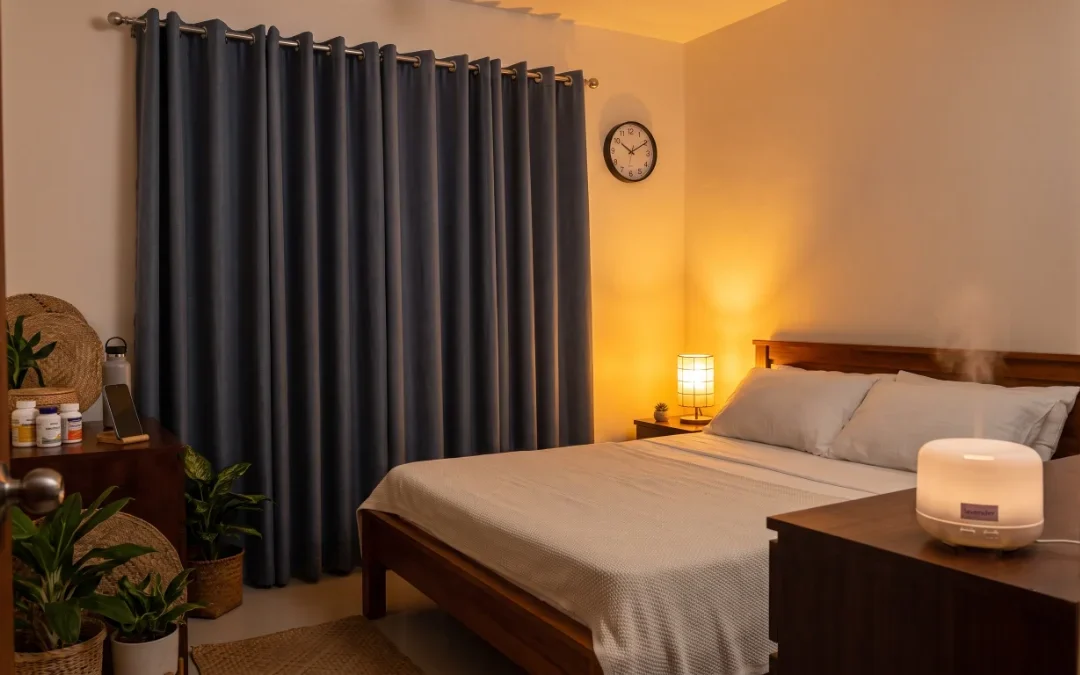
Kamusta, Ka-Optimalliving!
Important disclaimer: This article is for general informational purposes only and is not a substitute for professional medical advice. If you suspect a specific sleep disorder or medical condition, please consult a licensed healthcare professional for proper diagnosis and treatment.
From the “Vampire Shift” to the Sanctuary
For many years, I honestly did not understand how much the bedroom environment for sleep quality affects our health. Back when my brothers and I worked in our small shirt-printing business, sleep was not a routine. It was something that happened only when exhaustion won.
I would rest wherever there was space, even if that space was under the stairs or beside a table stacked with freshly printed shirts. As a young guy full of energy, I thought this was normal. I believed I could bounce back no matter what.
When I became a graphic designer in 2010, the habit followed me. I treated sleep like a backup plan instead of a daily anchor. I would work long hours because I felt I had to, especially when clients from different time zones were waiting for revisions.
Like many remote workers today, I carried the mindset that productivity meant pushing myself past my limits. But around 2018, I started reading about how long-term sleep problems affect hormones, metabolism, mental clarity, and even emotional stability. That hit me hard. It explained a lot of the burnout I was already feeling.
Even today, balancing time as an online worker is a struggle. I know many of you feel this too. It is so easy to bring work into the bedroom, to turn the bed into a second office, or to sacrifice rest just to finish another task.
But after living the vampire shift life for more than a decade, I realized the bedroom is not just a room. It is a recovery place. It is a health tool. And it is one of the few things we can actually control in a noisy, unpredictable world.
That is why I created this 7-step audit. It will help you transform your bedroom environment for sleep quality and give your body the real restoration it deserves. Whether you are a freelancer, remote worker, night-shift parent, or someone just trying to heal your schedule, these steps can help bring peace back into your nights.
Why Your Bedroom Environment for Sleep Quality Matters More Than You Think
Most Filipino households were not designed with sleep science in mind. We share rooms with siblings, cousins, or in-laws. We sleep near windows facing busy streets. We keep the TV or the aircon remote within arm’s reach of the bed, and we treat the bedroom as a storage room, an office, and a nursery all at once.
The problem is that your brain reads environmental cues constantly, even while you sleep. Light, temperature, sound, and even the texture of your sheets all send signals to your nervous system about whether it is safe and appropriate to rest. When those signals are mixed or wrong, your body stays partially alert even when you feel exhausted.
This is why so many of us wake up tired after what should have been a full night’s sleep. It is not always about how many hours you spent in bed. It is about how many of those hours were spent in a bedroom environment for sleep quality that actually supported deep, restorative rest.
The good news is that fixing this does not require an expensive renovation. Most of the changes in this guide cost little to nothing, and a few affordable additions from Lazada PH can genuinely accelerate the results. Let’s go through the 7 steps one at a time.
Step 1: Eliminate Blue Light from Electronics
Why Blue Light Hurts Sleep
Many studies show that blue light from screens suppresses melatonin. Melatonin is the hormone that helps your body relax and get ready for sleep. When blue light hits your eyes at night, it tells your brain that it is still daytime. This keeps you alert instead of sleepy, and the result is simple but damaging: it becomes harder to fall asleep, and the sleep you do get becomes shallow.
This is especially challenging for remote workers in the Philippines, and anywhere else in the world, where online jobs require evening or early morning shifts. Most of us use laptops and phones until the last minute of the day. I also did this for years because I wanted to maximize time. But after researching how blue light affects the bedroom environment for sleep quality, I realized I was making things harder for myself without even knowing it.
Blue light does not only affect melatonin. It also affects your brain temperature and heart rate, keeping your brain in “work mode,” which blocks the natural process that prepares your body for deep rest. Even dim screen brightness is enough to delay sleep, and once sleep is delayed, the entire sleep cycle becomes disturbed for the rest of the night.
How to Reduce Blue Light
You do not need to throw your gadgets away. You only need to change how you use them. Try limiting screen use 2 to 3 hours before sleeping. If your work schedule makes this hard, use blue-light-blocking apps or enable Night Mode on your phone and laptop.
Amber-tinted glasses also help reduce melatonin suppression, especially for people who cannot avoid screens late at night because of work. Wearing them during your last hour of screen time before bed is a small habit that makes a real difference over time.
Scenarios Where This Matters
If you are editing photos at 11 PM, your body will still think it is 6 PM. If you watch K-dramas in bed, your brain becomes too stimulated to wind down. If your phone is the last thing you look at before sleeping, your mind will take longer to power down.
All these habits weaken your bedroom environment for sleep quality, even if you do not notice it right away. The fix does not need to be perfect. Even cutting your pre-bed screen time in half is a genuine improvement.
👉 If you or your kids are glued to screens most of the day, I have blue light blocking glasses on my Recommended Wellness Finds page that are worth checking out.
Step 2: Calibrate the Thermostat for Restorative Sleep
Why Temperature Matters
Experts say the ideal room temperature for sleep is 60 to 68 degrees Fahrenheit, or roughly 16 to 20 degrees Celsius. This may seem cold for many Filipino households, but the science is very clear. As your bedtime approaches, your body naturally cools down, and this drop in core temperature helps your brain start the sleep cycle.
When your room is too warm, your body struggles to cool down, and this delays the release of melatonin. According to medical experts at Cleveland Clinic, warm rooms above 70 degrees Fahrenheit interfere with the natural temperature drop required for restorative sleep.
How Temperature Affects Sleep Stages
If your room is too hot, your body stays in light sleep, and you will keep waking up without knowing why. You also lose a lot of REM sleep, which is the stage that helps with memory, creativity, and emotional balance. As someone who spent years doing vampire shifts, I often woke up feeling tired even after long sleep hours, simply because my room was too warm.
Over time, chronically disrupted temperature regulation can make you feel like you never actually get “deep” rest, no matter how many hours you log. This is one of the most overlooked parts of a bedroom environment for sleep quality, because most Filipinos assume feeling hot at night is just normal tropical weather, not a fixable sleep problem.
Practical Tips for Filipinos and Global WFH Workers
If you cannot set a thermostat or run aircon all night because of the electric bill, try these instead. Use a fan aimed at the wall rather than directly at your body, so it circulates air evenly across the room. Use breathable blankets instead of thick comforters, and avoid using devices that heat the room, like heavy gaming laptops, near bedtime.
Trying a cooling pillow is also worth considering if you live in a tropical area and tend to overheat while sleeping.
Real-Life Scenario
If you work nights and sleep during the morning, your room may be even warmer because of daytime sunlight coming through the windows. This is exactly where blackout curtains and cooling bedding become useful, since they block heat as well as light.
These simple changes strengthen your bedroom environment for sleep quality and make resting easier, even during the hottest months of the year here in the Philippines.
Step 3: Block Out Artificial Light Sources
Why Darkness Works
Light is the strongest cue for your circadian rhythm. According to sleep research, the suprachiasmatic nucleus, or SCN, is the master clock of the body, and it responds directly to light signals detected by your eyes. Even small light from a hallway or a charger LED can interrupt melatonin production throughout the night.
When you sleep in a room with too much light, your internal clock becomes confused. It thinks morning has arrived too early, so it pushes you into a lighter sleep stage well before you are actually rested. This is why many people wake up at 3 AM or 4 AM without any clear reason, then struggle to fall back asleep.
Why This Is Tough for Remote Workers
Many Filipino remote workers share rooms with family. Some live near busy streets with bright lights, and some sleep during the day because their work hours follow US or Australian clients. These situations make it even more important to create a genuinely dark sleeping environment, since you cannot rely on nighttime darkness alone.
What You Can Do
Block every source of light you can find. Blackout curtains help reduce outside light significantly, and eye masks help block indoor light when curtains alone are not enough. Cover LED indicators on chargers or Wi-Fi routers with a small piece of tape or electrical cover.
Small adjustments like these can significantly improve your bedroom environment for sleep quality, and most of them cost less than a hundred pesos to implement.
Scenario Example
If your partner stays up watching TikTok videos beside you, the flashing lights can disrupt your sleep even if you already have your eyes closed. If you sleep in a condo with bright city lights outside, your brain may never fully enter deep sleep.
Darkness is not just about comfort. It is a biological signal your body genuinely needs in order to complete a full, restorative sleep cycle.
Step 4: Swap to Sleep-Friendly Bedroom Lighting
The Problem With Common Lights
Most indoor lights today use LEDs. These are energy-efficient but high in blue wavelengths, and research shows that blue wavelengths delay melatonin production, making your brain more alert instead of relaxed. This becomes a genuine problem if your household lights are too bright during the evening hours.
How Color Affects Sleep
Warm-colored light, like red or orange tones, does not interfere with melatonin nearly as much. These colors create a calming effect and help prepare the mind for sleep. Warm light signals rest, while cold, bright white light signals work and alertness.
Many of us unknowingly use bright white LED bulbs throughout the entire house, including the bedroom, which quietly hurts sleep without us ever realizing the cause.
How to Fix This
Change your bedroom bulbs to warm or amber tones, especially the ones near the bed. Use small night lamps instead of ceiling lights when preparing for sleep, since ceiling lights tend to flood the whole room. If you cannot change the bulbs themselves, cover bright fixtures with lampshades that soften the brightness.
You can also lean on Night Mode on your phones and laptops during the evening to reduce blue light exposure while you finish up work.
Scenario Example
When I was younger, I slept under bright fluorescent lights often, especially while working late on design projects. Those lights kept my brain active even when my body was already tired.
Switching to warm lighting helped me slow down at night and improved my bedroom environment for sleep quality more than I expected, and it is one of the cheapest fixes on this entire list.
Step 5: Implement Pre-Sleep Temperature Regulation Tactics
Why the Body Must Cool Down
Before sleep, the body starts a natural cooling process called vasodilation, sending warm blood to the hands and feet so heat can leave your body faster. This drop in core temperature signals your brain that it is time to rest. Sleep experts note that a warm bath 1 to 2 hours before sleeping genuinely encourages this process.
The Warm Bath Trick
A warm bath may sound like it would heat you up, but it actually helps you cool down afterward. When you step out of the warm water, your skin rapidly releases heat into the surrounding air. This rapid heat release helps your body enter sleep mode faster than it would otherwise.
Simple Ways to Help Your Body Cool
If you cannot take a warm bath every night, try washing your face or feet with warm water before bed instead. Drinking warm tea in the evening can have a similar effect, and avoiding heavy exercise within two hours of bedtime helps prevent your core temperature from staying elevated too late into the night.
These small habits help your internal cooling system function the way it is designed to.
Why This Matters
If your body struggles to cool down properly, you will take longer to fall asleep and may wake up frequently throughout the night. This weakens your bedroom environment for sleep quality and makes your rest feel incomplete, even after eight full hours in bed.
Step 6: Optimize Bedding and Sleepwear for Heat Dissipation
Why Fabric Matters
Your bedding directly affects how your body releases heat while you sleep. Thick blankets, synthetic sheets, or non-breathable pillows trap heat against your skin, causing your body to work harder to cool down, which interrupts deep sleep stages throughout the night.
Recommended Materials
Sleep experts recommend using breathable fabrics like cotton or bamboo, which allow air to circulate and help sweat evaporate naturally. Moisture-wicking sleepwear keeps your skin dry and cool, while cooling pillows help prevent heat buildup specifically around your head and neck.
How This Helps You
When your bedding allows heat to escape properly, your body stays closer to the ideal sleep temperature for longer stretches of the night. This helps you stay in deep sleep longer, and it prevents the “hot wakeups” that interrupt sleep cycles right when you need them most.
Real-Life Scenario
During my vampire shift years, I often woke up sweating even with a fan running. My bedding was trapping heat against my body without me realizing it. When I switched to breathable sheets, my sleep quality improved almost immediately.
This one small change made my bedroom environment for sleep quality noticeably more supportive, and it remains one of the easiest, most affordable upgrades on this list.
👉 A good weighted blanket in breathable cotton and a supportive cervical pillow are both on my Recommended Wellness Finds page if you want options that are actually available on Lazada PH.
Step 7: Anchor Your Routine to Circadian Zeitgebers
Why Routines Keep You Healthy
Zeitgebers are daily cues that help keep your circadian rhythm aligned. Light, meals, activity, and consistent sleep times all help your body stay in rhythm. When these cues become irregular, your body becomes genuinely confused about when it should be sleeping or eating.
What Helps
Expose yourself to morning sunlight whenever your schedule allows it. Eat your meals around the same time daily, even on weekends, and move your body during the day rather than staying sedentary for long stretches. Sleep and wake up at consistent hours as much as your work schedule permits.
These cues, taken together, strengthen your internal body clock far more than any single change on its own.
Why Remote Workers Struggle With This
Many of us work odd hours depending on client schedules across different time zones. When nighttime feels like morning and morning feels like nighttime, your circadian rhythm weakens, and this affects your energy, mood, focus, and long-term health in ways that build up slowly over months.
When your daytime feels like nighttime, your biology needs more than just a dark room. It needs a full system reset. If you are struggling to stay awake during your shift, check out my Circadian Rhythm Reset for Night Shift: 7 Survival Tips article for a deeper dive into the science of the 3 AM slump.
Scenario Example
If you sleep at 4 AM one day and 10 PM the next, your internal clock becomes unstable and confused. Setting a clear, consistent routine helps your bedroom environment for sleep quality work the way it is supposed to, because your body starts expecting rest at the right time every single day.
Key Medical Facts and Common Myths
Myth 1: Warm rooms are comfortable for sleep. Fact: Warm rooms above 70°F reduce REM sleep. Your brain overheats, causing lighter, more fragmented sleep throughout the night.
Myth 2: Hot baths keep you warm all night. Fact: Warm baths actually trigger a rapid cooling response afterward, which helps you fall asleep faster, not slower.
Myth 3: All naps are good for you. Fact: Late afternoon naps can disrupt your circadian rhythm and make it noticeably harder to fall asleep at your intended bedtime.
Frequently Asked Questions about Bedroom Environment for Sleep Quality
Q1: Why does my room temperature affect my sleep quality so much? Your body needs to cool down to properly start the sleep cycle. If your room is too warm, your body works harder to regulate its own temperature, which leads to lighter sleep and frequent waking. Keeping your room between 60°F and 68°F supports deeper, more restorative sleep for most people.
Q2: Can small lights really disrupt my sleep? Yes. Even tiny LED lights can delay melatonin release, since your brain can detect light even through closed eyelids. This weakens your bedroom environment for sleep quality and can cause earlier waking than you intended.
Q3: What is the safest light color to use at night? Warm colors like red, orange, or amber affect melatonin the least. These tones are ideal for bedrooms because they help you wind down without stimulating your brain the way bright white or blue-toned light does.
Q4: Is using a fan enough to cool my body at night? A fan helps circulate air, but the type of bedding you use matters just as much, if not more. Breathable sheets allow heat to escape, which creates a better sleep temperature and improves your overall bedroom environment for sleep quality.
Q5: I work night shifts. How can I keep my circadian rhythm healthy? Use blackout curtains during daytime sleep, create a consistent sleep schedule as much as possible, and expose yourself to bright light right when you wake up. These cues help stabilize your circadian rhythm even while working against your body’s natural clock.
Conclusion: Your Bedroom Is a Health Tool, Not Just a Room
Improving your bedroom environment for sleep quality is not about buying expensive items. It is about understanding how your body actually works and giving it the signals it needs to properly rest. Small habits like dimming your lights, cooling your room, or switching to breathable sheets can create a genuinely big difference in your daily energy.
Your bedroom becomes a health tool instead of just a sleeping space.
For many years, I ignored these simple truths. I slept under stairs, on sofas, or on hot mattresses because I felt like I had no choice. But the older I got, the more I realized that rest is a form of self-respect. It is not laziness. It is maintenance. It is survival.
If you are reading this and you feel tired, burned out, or overwhelmed, I want you to know this: you deserve a peaceful sleeping space. You deserve a room that helps you recover. You deserve nights that heal you instead of draining you.
And as your neighbor here in Optimal Living PH, I am cheering for you. One step at a time, Ka-Optimalliving. We fix the room, we fix the rhythm, and we fix the energy for tomorrow.
Important: I am sharing my journey and research, but I am not a doctor. Please read our full [Disclaimer] before making changes to your health routine.
If a few of these steps resonated with you, I’ve also curated affordable sleep essentials on my Recommended Wellness Finds page, from cooling pillows to blackout-friendly accessories, all available on Lazada PH.
References
- Blue Light and Sleep – Sleep Foundation: https://www.sleepfoundation.org/bedroom-environment/blue-light
- Circadian Rhythm – Cleveland Clinic: https://my.clevelandclinic.org/health/articles/circadian-rhythm
- Best Temperature for Sleep – Sleep Foundation: https://www.sleepfoundation.org/bedroom-environment/best-temperature-for-sleep
- Ideal Sleeping Temperature for Your Bedroom – Cleveland Clinic: https://health.clevelandclinic.org/what-is-the-ideal-sleeping-temperature-for-my-bedroom
- Circadian Rhythm – Sleep Foundation: https://www.sleepfoundation.org/circadian-rhythm
The Optimal Setup: Gear for Peak Performance
I’m always searching for practical wellness tools for our community. I’ve recently partnered with Kwikcare to bring you special access to their products. While I’m just beginning to explore their range myself, you can check them out here and use my referral code: ftisagun to support the blog!

Medical Disclaimer
“I am a student of wellness by passion—but I am not a doctor, nutritionist, or licensed medical professional

About Thom Sagun
“I’m a Freelance VA, Computer Technician, father, and fur-parent. After 15 years of navigating the ‘Vampire Shift’ for global clients on different platforms where I get jobs to support my family, I founded Optimal Living PH. My mission is to document the journey of reclaiming my health while working on my own terms practically and to share it with everyone. I’m a researcher and wellness student, passionate about helping fellow independent workers find a better rhythm. Let’s fix the room, fix the rhythm, and build a better life together—it’s never too late to start, Ka-Optimalliving!”